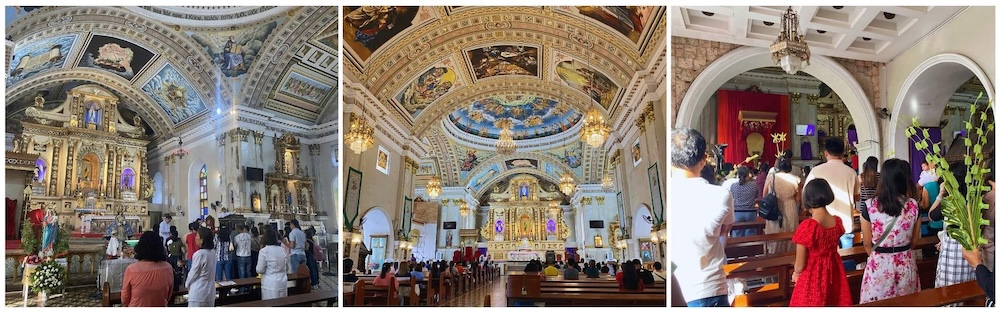
Bohol’s historic churches and cathedrals reflect a Catholic heritage shared throughout the Philippines
Image taken October 2025
Religion in the Philippines (2026): Catholic Faith - Spirtual Belief
Tolerant, diverse and spiritual, there is more to Asia's largest Catholic nation than meets the eye. While religion in the Philippines is dominated by Catholicism, the country's deep ancient beliefs and spiritual traditions leave traces in the culture and communities, shaping the people and the meaning of being Filipino.
Today's Philippines is far more faith-diverse than headlines suggest. Alongside the Catholic majority, you'll find long-established Muslim communities, growing Protestant and Born-Again groups, and independent Filipino Christian movements. Here, we look at the history of faith, the arrival of Islam, the influence of the Spanish, and the modern-day challenges that growing populations with changing expectations bring.

Table of Contents
This guide explores how faith shaped the Philippines from its earliest beliefs to the practices you see today.
1.Ancient Beliefs & Spiritual Traditions
4.Religious Diversity Across the Philippines
6.Conclusion – A Country Shaped by Faith

Filipino Society - Our Articles
The Philippines is a beautiful country, but when you look deeper you quickly realise it is the people who make it truly shine. Here we look deeper into the country’s history, culture, and the everyday realities and challenges of being Filipino in a modern world.




Ancient Beliefs & Spiritual Traditions
The Philippines has been home to people for tens of thousands of years, but the Austronesian communities who arrived around 4,000–5,000 years ago shaped the spiritual foundation we still recognize today. These early farmers, fishers, and seafarers settled in small coastal and river villages, connected by local trade and shared ways of seeing the world.
At the heart of their spiritual life was a deep respect for ancestors, nature spirits, and unseen forces that influenced everything from the harvest to health and fortune. They honoured anito (ancestor spirits and souls of the dead) and diwata (powerful nature deities and guardians), offering prayers, food, and rituals to keep harmony with the spirit world.
Guiding these practices were the babaylan or catalonan — respected spiritual leaders, often women, who served as healers, diviners, and bridges between people and the unseen. Through trance, chants, and ceremonies, they communicated with spirits, performed healings, and led community rites for every major moment: planting seasons, births, marriages, deaths, and protection from harm.
These ancient beliefs were never rigid or distant — they wove into daily life so completely that they created a flexible cultural core. When Islam later reached the south and Catholicism arrived with the Spanish, older traditions didn't vanish; they blended in, leaving traces that still color Filipino festivals, folk healing, and the way many connect with faith today.
The Arrival of Islam
Islam reached the southern Philippines by the late 1300s through peaceful trade and missionary work from Malay, Arab, and Indonesian merchants. Coastal communities in Mindanao and the Sulu Archipelago adopted the faith via trade connections, intermarriages, and local leaders who embraced Islamic law and governance.
Sultanates quickly formed: the Sultanate of Sulu emerged around the early 1400s under Sharif ul-Hashim, followed by the Sultanate of Maguindanao. These organized states developed their own rulers, Sharia-based laws, written traditions, and thriving ports linked to wider Southeast Asian networks.
Islam became deeply rooted in these areas — shaping politics, family life, community identity, and culture — well before European contact. It provided a unifying framework that strengthened local societies amid expanding trade.
By the 1500s, Muslim influence was already extending northward through trade routes, reaching parts of the Central Visayas and early Manila. Without Spanish colonization and its push for Catholicism from 1521 onward, Islam might have spread further across the islands. Instead, that expansion halted in the north and central regions, while Islam remained strong and resilient in Mindanao and Sulu — a foundation that continues to shape the Philippines' religious diversity today.

Your Health & Healthcare in the Philippines
Healthcare in the Philippines is a key concern for expats and long-term residents. There is no one-size-fits-all solution, so our guides explain the main options and how to choose the right coverage for your lifestyle and budget.


Catholicism and the Spanish
When the Spanish arrived in 1521 with Ferdinand Magellan, they brought Catholicism not just as a faith but as a way to organize society. Missions, church-centered towns, and new administrative systems helped the religion spread quickly across Luzon and the Visayas. Many local chiefs converted early, encouraging their communities to follow, and Catholic rituals aligned naturally with long-held beliefs in ancestors, spirits, and community ceremonies — making the transition feel familiar rather than foreign.
Under Spanish rule, religion and governance became deeply intertwined. Missionaries taught the faith while overseeing education, record-keeping, and much of local life. Civil authorities enforced colonial control, but everyday affairs were often shaped by the parish priest working closely with Filipino leaders known as the principalia. This partnership placed the Church at the heart of learning, administration, and community order, helping Catholicism take firm root across much of the archipelago.
In the Muslim south, however, the Spanish faced strong and sustained resistance. The sultanates of Sulu and Maguindanao had established Islamic law, rulers, and deep cultural identities. This sparked centuries of conflict — known as the Moro Wars — where Spanish forces struggled to extend control. Catholicism grew dominant in the northern and central islands, while Islam held strong in Mindanao and the Sulu Archipelago, preserving its own vibrant traditions.
Across the rest of the islands, older spiritual traditions blended into Catholic practice rather than vanishing. Anito spirits and household guardians became linked with Catholic saints, village rituals evolved into lively town fiestas, and offerings to ancestral figures shifted into prayers for protection, harvests, and healing. These natural parallels eased conversion and helped forge a distinct, deeply rooted form of Filipino Catholicism that still shapes faith and identity today.
Religious Diversity Across the Philippines
Although Catholicism became the dominant faith, it has never been the country's only one. Protestant churches arrived during the American period in the early 1900s, introducing new denominations along with schools, medical missions, and a focus on personal Bible study. In the decades since, Born-Again and evangelical movements have grown rapidly — especially in cities and among younger Filipinos drawn to a more direct, heartfelt style of worship.
In Mindanao and the Sulu Archipelago, Muslim communities continue to live out traditions shaped by centuries of local sultanates, Islamic scholarship, and deep-rooted cultural identity. This heritage — long predating Spanish arrival — remains vibrant and distinct, giving the southern Philippines its own enduring religious character.
The islands are also home to major independent Christian movements founded by Filipinos themselves, including Iglesia ni Cristo, El Shaddai, and other local churches that have built large national followings. Together, these groups — alongside Catholics, Protestants, Muslims, and smaller communities — form a far richer and more varied religious landscape than many outsiders realise: a living blend of global faiths and distinctly Filipino expressions that coexist and interact across the country today.

Destinations & Property
Choosing where to live long-term in the Philippines isn’t about finding one “best” location — it’s about understanding how different places support different lifestyles. Our guides explore popular expat destinations and explain how to find and manage property once you arrive.




The Catholic Faith Today
Today, Catholicism still shapes daily life in the Philippines more deeply than almost anywhere else in Asia. Many families open and close their days with prayer, local churches serve as vibrant community hearts, and the major milestones — birth, marriage, death — are marked by rites that draw entire neighbourhoods together in shared joy and support.
Religious festivals stand out as the year's most cherished moments. Christmas unfolds over months, beginning as early as September, with Simbang Gabi — the nine dawn Masses — drawing huge, candlelit crowds before sunrise. Easter holds equal weight, as Holy Week brings solemn processions, Passion plays, self-flagellation in some areas, and family reunions that quiet entire towns and cities.
These celebrations weave modern Filipino life tightly to both faith and heritage. Devotions to patron saints, town fiestas honouring local protectors, and massive pilgrimages like the Black Nazarene in Quiapo or the Peñafrancia in Naga remain profoundly rooted, blending official Catholic teaching with customs handed down through generations. At the same time, many younger Filipinos live the faith more flexibly — attending Mass less regularly but still cherishing traditions that give rhythm, meaning, and a sense of belonging to family and community life.
Conclusion – A Country Shaped by Faith
Faith in the Philippines is the product of many histories — from the ancient rituals of ancestor spirits and nature deities, through the arrival of Islam in the south, to centuries of Catholic influence under Spanish rule. Rather than replacing one another, these layers have blended and enriched each other, creating a way of life where spirituality remains deeply woven into family, community, festivals, and everyday culture. It is this rich, living mix — respectful of its diverse roots while still evolving today — that gives the Philippines its truly distinctive character and enduring sense of belonging.
Live in the Philippines - The Cost
We look at the real cost of living here in the Philippines, day to day realities and the $1000USD/Month question, fact or fiction, could you survive?


Frequently Asked Questions about Religion in the Philippines
What were the earliest religious beliefs in the Philippines?
Early Filipinos practised ancestor worship, honoured nature spirits and believed unseen forces shaped daily life. Communities were guided by babaylan or catalonan — spiritual leaders who performed healing and rituals. These beliefs provided structure and identity long before Islam or Catholicism arrived.
How did Islam first reach the Philippines?
Islam reached the southern Philippines in the 1300s through traders and missionaries from Malaysia and Indonesia. It took root in Mindanao and the Sulu Archipelago, where sultanates formed with their own rulers, written traditions and legal systems based on Islamic and local customs.
Why did Catholicism spread so quickly under Spanish rule?
Catholicism spread rapidly because the Spanish built church-centred towns, worked closely with local chiefs and made the parish system central to community life. Catholic rituals aligned well with existing beliefs, helping Filipinos adopt the new faith while retaining familiar traditions and ceremonies.
Did older Filipino beliefs disappear after conversion to Catholicism?
No. Many older beliefs blended into Catholic practice. Anito spirits became linked with saints, local rituals evolved into fiestas and traditional offerings turned into prayers for protection, harvests and healing. This blending created a distinct Filipino expression of Catholicism that endures today.
What makes the Philippines religiously diverse today?
Alongside Catholicism, the Philippines includes long-established Muslim communities, Protestant and evangelical churches from the American period, and Filipino-founded groups such as Iglesia ni Cristo and El Shaddai. Together these create a varied religious landscape found in few other Asian countries.
Why are Christmas and Holy Week so important in the Philippines?
Christmas and Holy Week blend Catholic teaching with deeply rooted cultural tradition. Christmas begins as early as September with Simbang Gabi, while Holy Week features processions, Passion reenactments and family gatherings that bring towns and cities to a near standstill each year.

© 2025 Live Life The Philippines. All rights reserved.
Back to Top